
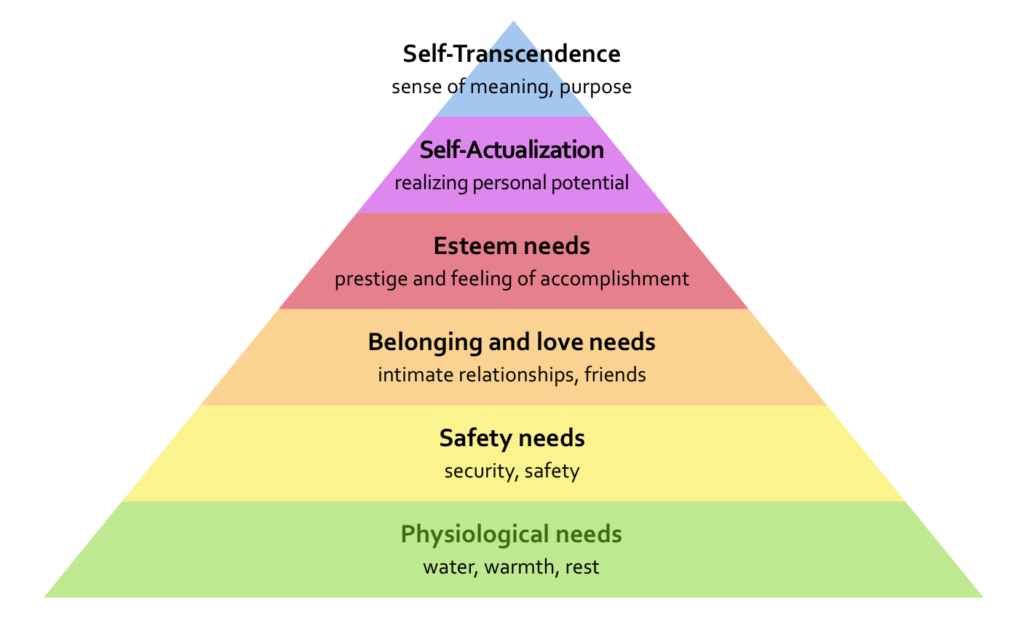
At this pivotal moment in human history, where conflict, division, and competition often dominate the global landscape, the question we must begin to ask ourselves is: What is the highest potential of human experience, and how do we access it? While Abraham Maslow’s hierarchy of needs has long provided a foundational map for understanding human motivation, his later work offers a profound key to personal and collective evolution: self-transcendence.
Maslow originally identified self-actualization as the highest human need, the desire to realize one’s fullest potential. This includes creativity, authenticity, personal growth, and the pursuit of purpose. Yet as Maslow continued his exploration into the human psyche, he identified something even higher: the need for self-transcendence.
Self-transcendence is the experience of going beyond the individual self to connect with something greater, be it service to others, the divine, nature, or the vast mysteries of the universe. This level of human experience is marked by a deep sense of unity, purpose, and connection. It integrates both personal fulfillment and the impulse to contribute to the collective good.
In a world that often reinforces the “dog-eat-dog” mentality, self-transcendence invites us into a different paradigm. One that asks not “What can I get?” but “What can I give?” This shift is not just morally or spiritually desirable; it is crucial for our survival as a species. If we continue to operate from fear, scarcity, and competition, we remain trapped in cycles of suffering. But if we evolve toward love, unity, and wholeness, we unlock the highest capacities of our humanity.
Self-transcendence is not merely an individual journey; it has the potential to transform society. It represents the highest state of human evolution, where we transcend the limitations of the ego and connect with a greater purpose. This journey involves moving beyond our self-centered desires and recognizing that we are part of a larger, interconnected whole. It is not about escaping the world but engaging with it at a higher level, seeing the shared humanity in every being.
When we practice self-transcendence, we tap into a deeper awareness that allows us to move beyond the boundaries of our own ego, our biases, and our fears. This expanded consciousness helps us understand that the pain and suffering of others are not distant or unrelated to us. We begin to realize that the suffering of one is the suffering of all, and this understanding calls us to act with compassion, empathy, and a sense of shared responsibility.
The Role of Self-Transcendence in Alleviating Global Suffering
Our world is plagued by inequality, poverty, violence, and injustice, issues that have existed for centuries and seem insurmountable at times. However, self-transcendence offers a powerful tool to address these injustices. It helps shift our mindset from one of competition and scarcity to one of cooperation and abundance. This shift in perception is not just philosophical; it can have a profound impact on the way we organize society, create policies, and allocate resources.
- Compassionate Service: When we transcend the limitations of our individual desires, we develop a deep sense of compassion for others. We are no longer bound by the walls of our ego but see others as reflections of ourselves. This leads to acts of service and social action, as we feel compelled to alleviate suffering wherever it is found, whether that means advocating for fair wages, providing resources to those in need, or simply listening to and supporting someone who is struggling.
- Shifting from Scarcity to Abundance: Much of the suffering in the world arises from the belief in scarcity that there is not enough to go around. This mindset leads to hoarding, competition, and exploitation. Self-transcendence, however, invites us to see the world through a lens of abundance. It reminds us that there is enough for all, and that collective prosperity is possible if we work together for the common good. By embracing this mentality, we begin to break down the systems that perpetuate poverty and injustice, creating space for global cooperation and equitable resource distribution
- Healing Divides: At the heart of many global conflicts are divisions, whether based on race, religion, nationality, or class. These divisions are rooted in the ego’s need to define itself in opposition to others. Self-transcendence asks us to see beyond these artificial boundaries, recognizing that we are all connected as part of the same global family. By transcending these divisive identities, we can foster unity, peace, and mutual respect. We can move beyond “us vs. them” mentalities and work toward solutions that benefit everyone, creating a more just and harmonious world.
- Global Consciousness: As more individuals engage in the practice of self-transcendence, we collectively begin to shift the consciousness of humanity. Our focus moves from survival and self-interest to global well-being and sustainability. This shift can have profound effects on how we address issues like climate change, human rights, and peacebuilding. As we evolve, we become more attuned to the needs of the planet and the suffering of all living beings, recognizing that the health of the Earth and its people are inseparable.
The Responsibility of Having Our Needs Met
When we are fortunate enough to have most of our basic needs met, our safety, belonging, self-esteem, and even our creative expression, it is not a time to become complacent. Instead, it is an invitation to reach out beyond us. Self-transcendence calls us to recognize that our abundance is not only a blessing but a responsibility.
If we stand on stable ground, it is our privilege and indeed our sacred duty to extend a helping hand to those who are still climbing. Paying it forward becomes an act of love and justice, a way of honoring the interconnectedness of all life. Our fulfillment is deepened, not by what we accumulate for ourselves, but by what we give away in service to others.
Whether through mentorship, community involvement, acts of kindness, or advocating for systemic change, each of us has something to offer. When we lift another, we rise together. The world is healed not by a single grand gesture, but by countless small acts of courage, generosity, and compassion. In paying it forward, we participate in the great unfolding of human evolution, moving closer to a world where wholeness, dignity, and opportunity are available to all.
The Role of the Human Ego in Self-Transcendence
It is crucial to understand the role of the human ego in this journey. We need a healthy ego to navigate life effectively, to set boundaries, to experience self-worth, and to confidently express our individuality. A healthy ego is characterized by humility, resilience, self-respect, and the ability to connect authentically with others without domination or submission.
When the ego becomes wounded and fearful, it distorts into self-absorption, defensiveness, and control. The more fearful we become, the more narcissistic we tend to become. Narcissism, at its core, is an excessive preoccupation with oneself, often masking deep feelings of inadequacy and fear. It creates an illusion of separation, “me against the world,” and prevents true connection, empathy, and cooperation.
Self-Transcendence as a Call to Action
Self-transcendence is not just a lofty ideal or abstract concept; it is a call to action. It is a recognition that the pain of the world is our pain, and that the healing of the world starts with the healing of our own hearts and minds. We cannot turn a blind eye to the suffering around us and expect things to change. The path of self-transcendence invites us to act with integrity, compassion, and courage in the face of suffering.
In practical terms, this might mean:
- Advocating for systemic change: We cannot expect individuals to transcend their suffering if the systems around them are designed to keep them in poverty, inequality, and oppression. Self-transcendence encourages us to work toward creating policies that promote equality, justice, and access to resources for all.
- Personal and collective responsibility: While the problems we face are immense, self-transcendence teaches us that even small acts of kindness, empathy, and compassion have a ripple effect. By taking personal responsibility for our actions and supporting others in their journeys toward self-transcendence, we contribute to the collective healing of humanity.
- Creating a new vision for the future: The pain and suffering of today are not permanent. Through self-transcendence, we can begin to co-create a future where love, peace, and unity reign. By aligning our actions with our highest values, we can help shape a world where every person can thrive, and suffering is no longer the norm.
Leading Together
As we move toward a world rooted in self-transcendence, we must recognize that leadership is not just the responsibility of a single individual or a select few. It is a collective responsibility that requires the participation of all of us. In a time of global challenges, social, environmental, and political, looking for a singular leader is no longer enough. We are all called to lead, not from positions of power, but from a deep place of empathy, compassion, and love.
True leadership arises when we understand that we are all part of the same human family. It calls us to act not for our personal gain, but for the well-being of the collective. Leadership is not only about making decisions but about inspiring others to act in ways that uplift humanity. It is about demonstrating compassion for those who are suffering, taking responsibility for the injustices in our world, and working tirelessly to create a future that reflects the highest values of peace, equity, and harmony.
In this collective leadership, we must lead with empathy, understanding that the struggles of others are our struggles. We must lead with compassion, working to ease the suffering that exists around us. We must lead with action, turning our values into tangible results. And above all, we must lead with love, a love that transcends boundaries, that unites us in our shared humanity, and that motivates us to take bold steps toward healing our world.
Each of us has the potential to be leaders. The path of self-transcendence invites us to step into our fullest potential, not as isolated individuals, but as members of a global community. Together, we can create a world where leadership is not defined by titles or power but by our collective commitment to making the world a better, more just, and loving place for all.
By embracing the principles of self-transcendence, we not only unlock the highest potential within ourselves but also contribute to a world where fairness, compassion, and justice are the guiding forces. This evolution is not a passive process but an active choice we make every day.
2025 Irma Francis – www.irmafrancis.com